Algorithmic Identification of Non-Human Biological Traits
Animal biometric leverages immutable, high-entropy morphological and dermatoglyphic structures to establish
individual identity without physical mutilation, foreign body implants, or reliance on detachable livestock
tags.
Traditional animal tracking methodologies—predominantly plastic ear tags, freeze-branding, ear notching, and
radio-frequency (RFID) rumen boluses—suffer from structural attrition. Empirical studies document ear tag loss
rates between 8% and 22% annually under pasture conditions, coupled with wound infections, tissue tearing, and
vulnerability to fraudulent tag swapping in insurance and breeding claims.
Non-invasive biometric identification utilizes computer vision pipelines to analyze unique anatomical features:
the beaded groove architecture of bovine and canine muzzles (analogous to human friction ridges), ocular
trabecular meshwork in equines and ovines, and the mathematical geometry of wildlife coat striping. These
patterns remain structurally invariant after juvenile stabilization.
0.002%False Accept RateAchieved at 0.88 cosine similarity threshold on verified test corpora.
100%Non-Invasive CaptureZero physical contact, zero ear splitting, and zero handling trauma.
0.0%Tag Detachment LossInherent anatomical trait cannot fall off, tear, or be swapped.
< 240msInference LatencyEdge mobile execution time for 512-dimensional vector embedding.
Section 01
Biometric Modalities & Anatomical Foundations
High-Entropy Biological Structures
Biometric uniqueness across non-human species relies on organs and skin layers that exhibit high phenotypic
variability during morphogenesis. The three predominant modalities in operational deployment are detailed below.
Planum Nasolabiale Dermatoglyphic Patterning
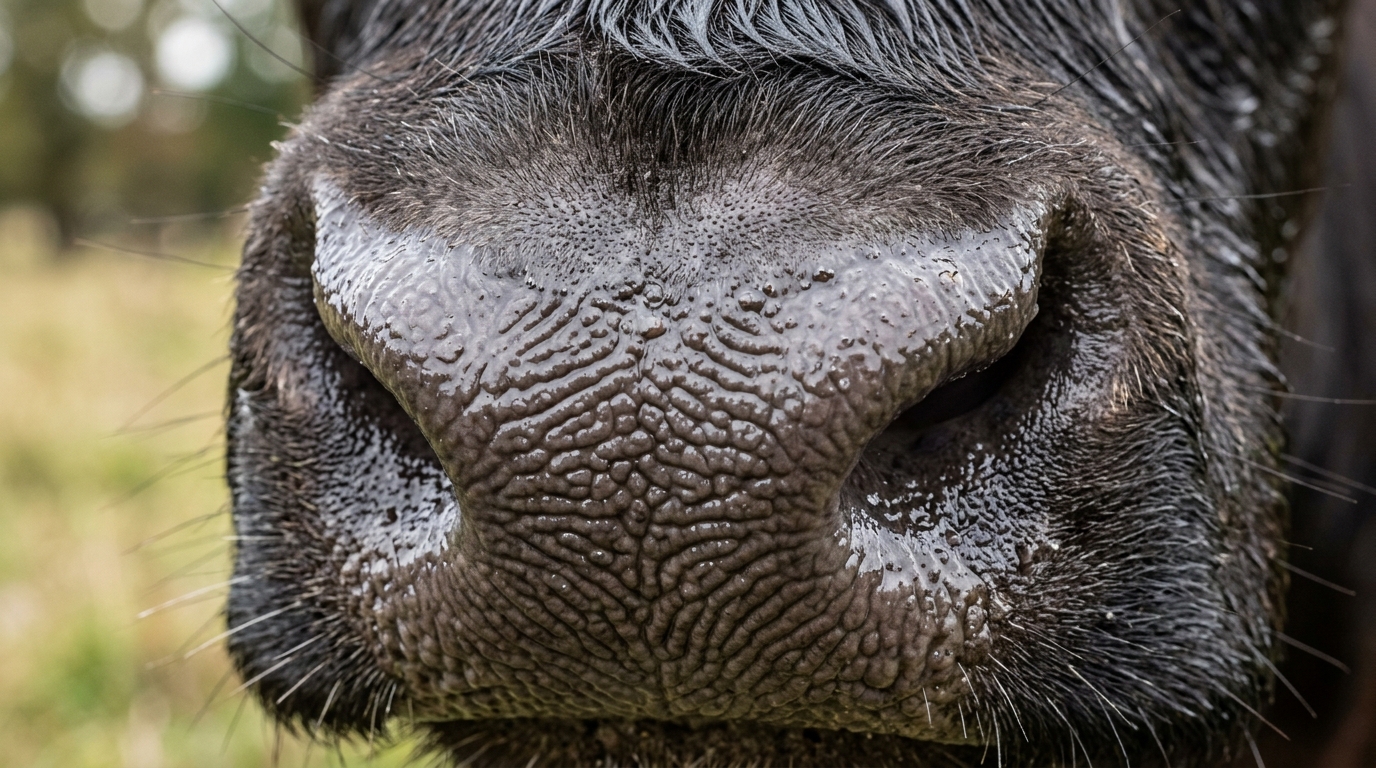
The cattle muzzle (planum nasolabiale) exhibits an intricate topology composed of epidermal ridges,
grooves, and sweat pore arrangements. First cataloged by veterinary anatomists in the early 20th century
via manual ink printing, these patterns possess individual distinctiveness comparable to human
fingerprints.
Anatomical Permanence & Stability
Epidermal ridge arrangements form during gestation and remain persistent throughout the animal's
lifetime. While juvenile growth expands the overall surface area, the spatial graph topology
(neighbor-point connectivity) remains affine-invariant after 6 to 9 months of age.
Macro capture displaying the sweat pore pits and papillary ridges. Computer vision algorithms
isolate the specular reflection of moisture to accurately segment groove valleys.
Iris Trabeculae & Choroidal Vasculature
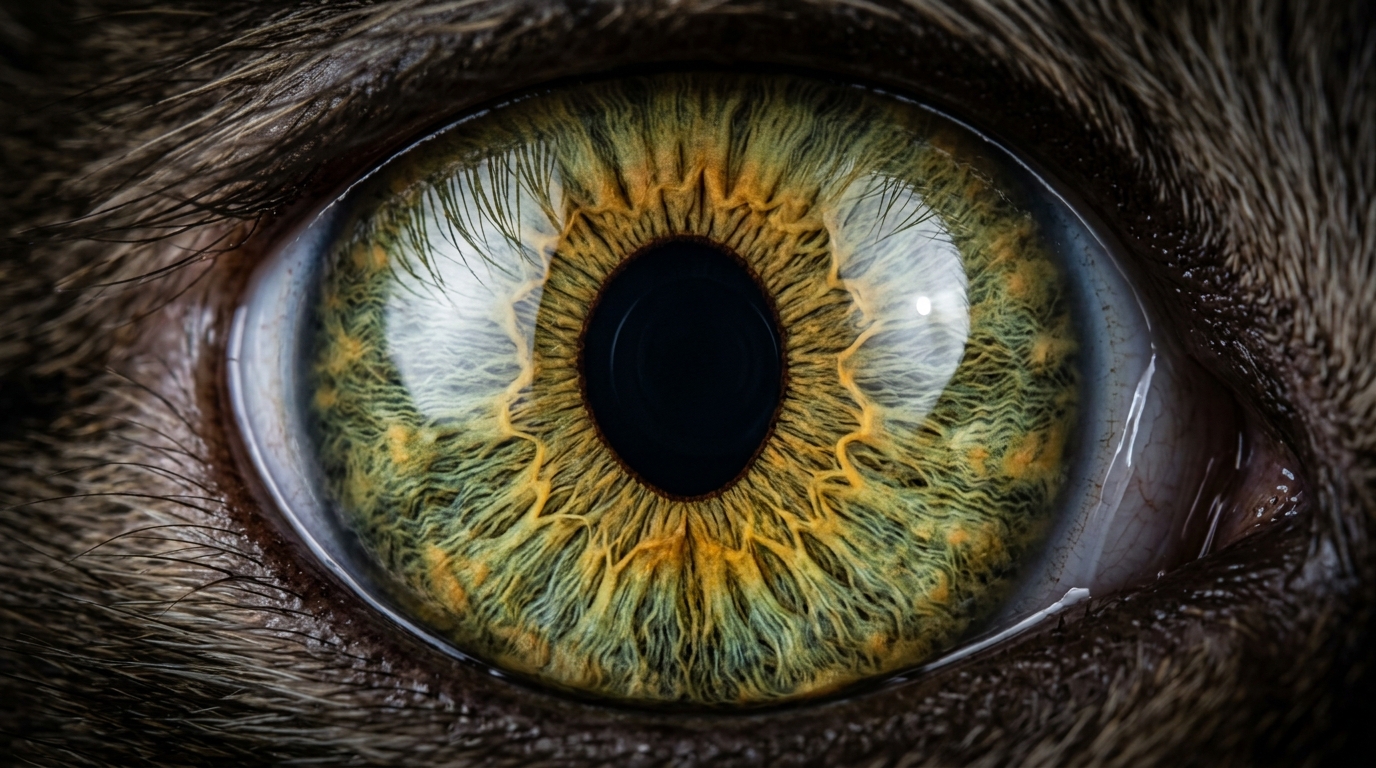
Ocular biometric in horses, sheep, and dogs leverage the micro-architectural texture of the iris
stromata or the fundus vascular tree. The fibrous stroma exhibits deep crypts, collarettes, and
pigmentary granularity that develop under chaotic epigenetic processes, guaranteeing uniqueness even
between bilateral eyes of the same animal.
Near-Infrared (NIR) Illumination Advantage
Standard visible light causes rapid pupil constriction in ungulates. NIR illumination in the
780nm–880nm spectrum bypasses heavy melanin absorption in dark irises, exposing the trabecular
meshwork without triggering reflexive blinking or photophobia.
High-magnification scan of iris collarette and fibrous connective bands. Texture vectors are
normalized from polar coordinates into dimensionless rectangular matrices.
Pelage Striping & Rosette Geometry
In wildlife conservation and census tracking, invasive darting or ear-tagging carries mortality and
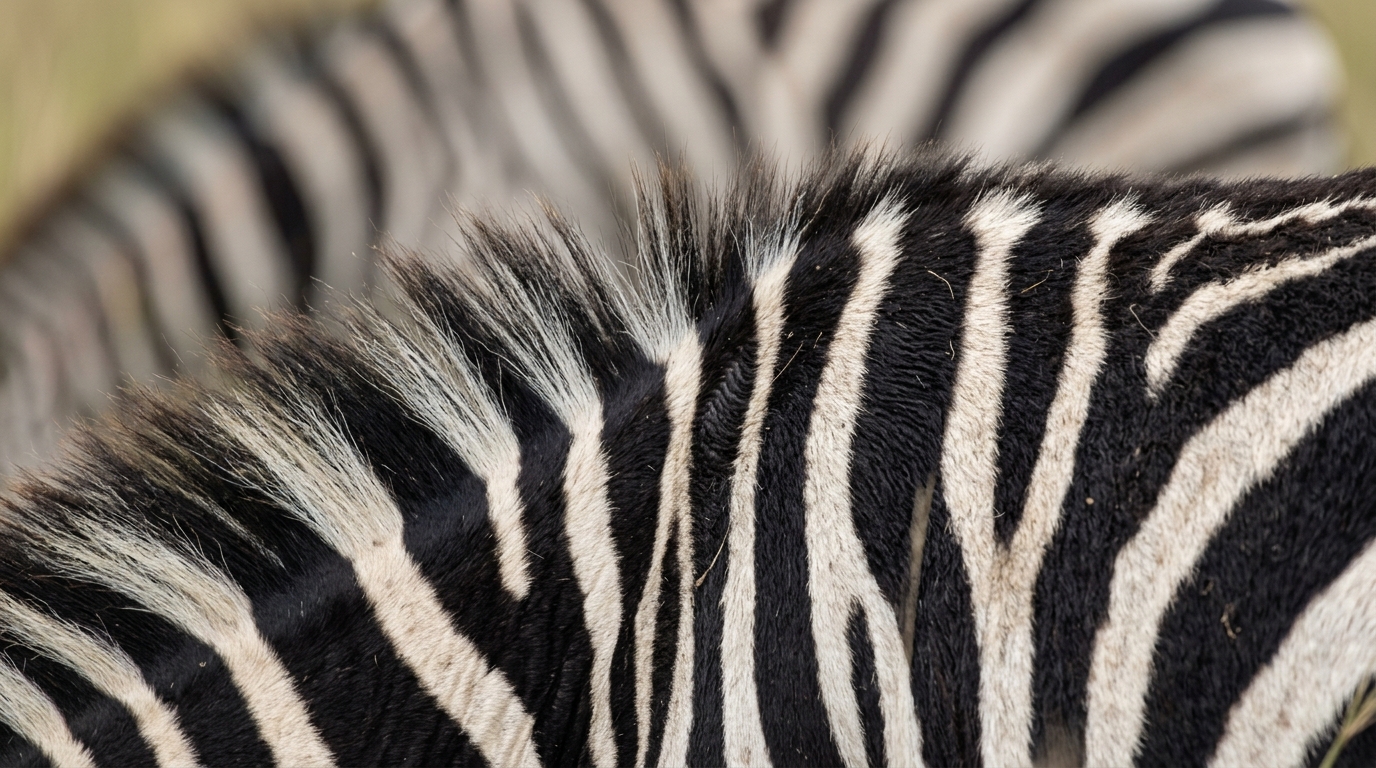
behavioral risks. Computer vision algorithms exploit natural pigmentation patterns—such as zebra
stripes, cheetah rosettes, and giraffe coat reticulations—to identify individual animals from
long-distance optical or drone footage.
Turing Reaction-Diffusion Uniqueness
Melanocyte pigment synthesis during embryonic development follows non-linear reaction-diffusion
differential dynamics. The resulting bifurcations and stripe frequencies are distinct to each
individual, forming a biological barcode.
Verification EER1.15% (Varies by occlusion and pose angle)
Specimen: Striped Pelage
Pelage Bifurcation Points
Edge transitions between pigmented and non-pigmented hair follicles provide scale-invariant
geometric descriptors for non-invasive mark-recapture census monitoring.
Section 02
Computer Vision Processing Pipeline
From Optical Capture to High-Dimensional Vector Matching
Biometric authentication of non-cooperative subjects requires a resilient multi-stage pipeline designed to
eliminate variable lighting, motion blur, and non-rigid head movements.
01
Optical Frame Acquisition
Burst-mode video capture (30–60 fps) coupled with Laplacian variance filtering to automatically discard
frames exhibiting motion blur or focal distortion.
02
ROI Segmentation
Deep convolutional object detection (YOLOv8-Seg or lightweight MobileNet backbone) isolates the anatomical
region of interest (e.g. muzzle or ocular perimeter).
03
Normalization & Glare Removal
Specular glare extraction via chromaticity analysis. Affine geometric rectification standardizes rotation,
scale, and perspective tilt.
04
Embedding Generation
Vision Transformer or ArcFace-optimized residual neural network extracts a unit-normalized 512-dimensional
dense feature representation vector.
05
Vector Search & Verification
Hierarchical Navigable Small World (HNSW) graph search compares the query vector against registry embeddings
via Cosine Distance metric.
Section 03
Interactive Threshold & ROC Curve Simulator
Operational Trade-off Analyzer
In all biometric verification architectures, adjusting the decision threshold (τ) governs the fundamental
trade-off between the False Match Rate (FMR) and the False Non-Match Rate
(FNMR). Adjust the slider below to observe how the operating point affects system reliability and
verification verdicts.
Dynamic policy categorization based
on error probability.
False Match Rate
(FMR)
0.082%
Probability of incorrectly accepting a non-matching
animal.
False Non-Match
(FNMR)
0.491%
Probability of rejecting a genuine matching
animal.
Composite
Accuracy
99.75%
Empirical balanced accuracy across benchmark
verification sets.
Sample Test Pair
Cosine
0.842
Hypothetical probe vector similarity against enrolled
record.
AUTHENTICATED MATCH (Similarity 0.842 >= Threshold 0.82)
Algorithmic Decision Engine
Section 04
Comparative Identification Matrix
Phenotypic Biometric vs. Physical Tagging Systems
The following matrix contrasts non-invasive biometric recognition against prevailing agricultural and veterinary
identification methods across critical operational dimensions:
Identification Method
Invasiveness
Tamper Resistance
Annual Loss Rate
Lifetime Durability
Hardware Cost
Animal Welfare
Muzzle Print Biometric
Non-Invasive
High (Anatomical)
0.0%
Lifetime (Permanent)
Standard Smartphone Camera
Zero Stress / Contactless
Iris / Ocular Scan
Non-Invasive
High (Anatomical)
0.0%
Lifetime (Permanent)
Specialized NIR Optical Rig
Minor Close Handling
Visual Ear Tag (Plastic)
Moderate (Ear Piercing)
Low (Cut / Swapped)
8.0% – 22.0%
2 – 5 Years (Snag Prone)
Inexpensive Consumables
Pain, Tissue Infection Risk
RFID Rumen Bolus
Internal Ingestion
High (Internal)
< 1.0% (Regurgitation)
Lifetime (In Reticulum)
Dedicated LF/HF Scanner
Stressful Balling Gun Ingestion
Hot-Iron / Freeze Branding
Severe (Third-Degree Burn)
Medium (Scar Distortion)
0.0%
Permanent Hide Scar
Branding Irons & Fuel
Severe Pain, Hide Degradation
Subcutaneous RFID Microchip
Needle Implantation
Medium (Migration Risk)
1.5% – 4.0% (Migration)
10 – 15 Years
Handheld Transponder Wand
Minor Needle Puncture
Section 05
Field Constraints & Edge Cases
Production Implementation Realities
While non-invasive biometric systems eliminate physical loss, deploying computer vision models in active
barnyards, livestock sales rings, and wild habitats introduces real-world impediments:
Environmental
Mucus, Saliva & Mud Occlusion
Bovine species frequently lick their muzzles, depositing moisture films or pasture mud across the
papillary valleys. Moisture reflects ambient light, creating severe specular blowouts in standard RGB
sensors.
ENGINEERING MITIGATION:
Cross-polarization optical filters paired with automatic glint removal segmentation networks to filter
out specular saturated pixels prior to feature extraction.
Biological
Juvenile Morphological Growth
Calves and young equines undergo rapid skull and muzzle dimension expansion during the first six months of
life. While topological pore connectivity is fixed, simple Euclidean pixel coordinates scale non-linearly.
ENGINEERING MITIGATION:
Self-supervised graph convolutional embeddings that model landmark Delaunay triangulation, preserving
relative angular distance rather than absolute scale.
Optical
Non-Cooperative Rapid Subject Movement
Animals do not maintain stationary gaze on optical lenses. Rapid head tossing and avoidance maneuvers
produce severe rolling-shutter artifacts and motion smear.
ENGINEERING MITIGATION:
High-shutter-speed burst acquisition (>=1/500s) coupled with an edge-evaluated blur detection
algorithm that selects only the sharpest 3 frames per capture sequence.
Environmental
Uncontrolled Rural Lighting Variation
Field capture takes place across deep pen shadows, harsh midday direct sunlight, and dim indoor handling
chutes, causing severe color casts and dynamic range clipping.
ENGINEERING MITIGATION:
Histogram equalization, multi-scale Retinex illumination normalization, and training models with heavy
synthetic photometric data augmentations.
Section 06
Standards Compliance & Interoperability
Global Livestock Framework Alignment
ISO/IEC 19794 Adaptation
Adaptation of biometric data interchange standards to accommodate non-human species records, defining
canonical coordinate planes, landmark geometry schema, and lossy compression tolerances.
WOAH / OIE Guidelines
Alignment with the World Organisation for Animal Health standards on animal identification and traceability,
ensuring compliance with disease surveillance and cross-border transport tracking.
Zero-Tamper Cryptography
Biometric vectors are coupled with device-signed cryptographic timestamps, preventing replay attacks and
guaranteeing provenance across distributed livestock registries.